
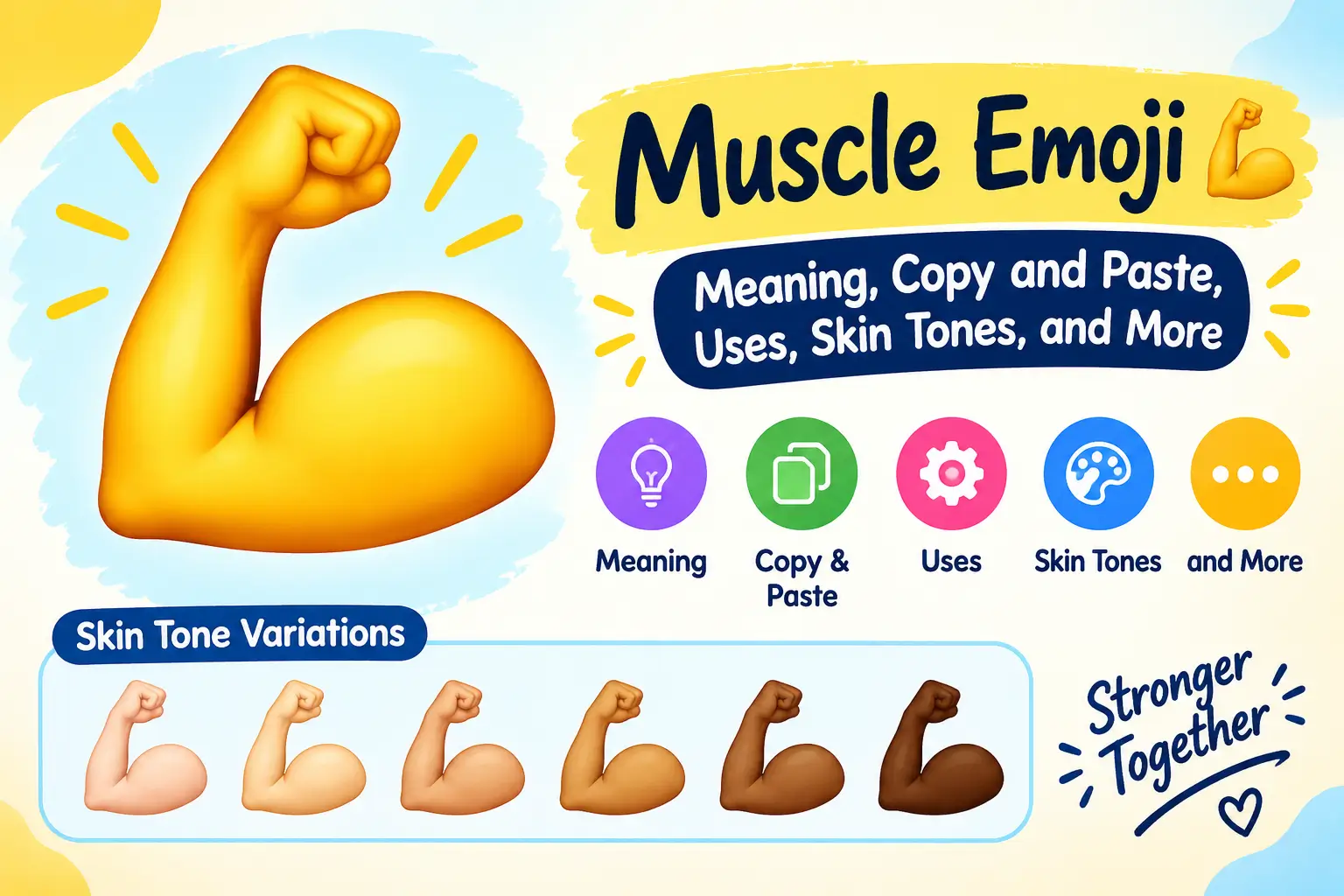
The 💪 emoji is one of the easiest symbols to recognize. It shows a flexed arm with a visible biceps muscle, so its most obvious message is strength. Yet digital conversations have stretched its meaning far beyond bodybuilding and gym workouts.
Today, people use 💪 to celebrate achievements, encourage friends, show determination, talk about exercise, or simply say, “I’ve got this.” A small symbol can carry quite a bit of emotional weight.
Officially, Unicode calls it “Flexed Biceps.” The character is represented by U+1F4AA and was approved in Unicode 6.0 in 2010. It later became part of Emoji 1.0 in 2015.
Whether you found it in a text message, Instagram caption, gym post, or group chat, understanding the context makes its meaning much clearer.
💪 What Does the Muscle Emoji Mean?
At its core, 💪 represents strength and power. That strength can be physical, emotional, mental, or symbolic.
Someone might send it after completing a difficult workout. Another person might use it after finishing a challenging project. A friend could send it when encouraging you before an important exam.
The meaning usually depends on the words around it.
For example:
“Finally finished my workout 💪”
Here, the emoji refers to physical strength and exercise.
Compare that with:
“You’ve got this! 💪”
Now it represents encouragement and confidence rather than muscles.
The same symbol can therefore act like a tiny visual adjective. It adds a feeling of strength, resilience, confidence, or determination to whatever comes before it.
Common Meanings of 💪
| Meaning | Typical Use |
| Physical strength | Gym sessions, sports, lifting weights |
| Motivation | Encouraging someone to keep going |
| Determination | Facing a difficult task |
| Achievement | Celebrating a completed goal |
| Confidence | Showing belief in yourself |
| Support | Cheering someone on |
| Resilience | Getting through a difficult situation |
| Pride | Celebrating personal progress |
| Playful boasting | Showing off an accomplishment |
The emoji’s official description focuses on a flexing biceps muscle and strength. Its broader digital use includes both physical and metaphorical “feats of strength.”
What Does 💪 Mean in Texting?
In texting, 💪 often means “stay strong,” “you can do it,” “nice work,” or “I’m with you.”
It can also work as a quick response when words aren’t necessary.
For example:
Friend: “I have my final interview tomorrow.”
Reply: “You’re going to crush it 💪”
The emoji reinforces the encouragement. It makes the message feel warmer and more energetic.
You might also see it after a small accomplishment:
“I finally cleaned my entire apartment 💪”
Nobody expects the person to have developed superhero-level muscles while cleaning. The emoji simply adds a playful sense of achievement.
That’s one reason 💪 works so well in casual communication. It can be serious, supportive, motivational, or humorous without changing its basic visual identity.
Also read this:Devious Emoji: Meaning, Copy and Paste, and How to Use It
Muscle Emoji Copy and Paste
Here is the standard emoji:
💪
You can copy and paste it directly into texts, captions, comments, emails, profiles, and social media posts.
The official Unicode code point is U+1F4AA. Unicode also identifies the character as Flexed Biceps.
If you want a simple strength symbol without writing a full sentence, 💪 gets the point across immediately.
How to Use the 💪 Emoji
The strongest use cases fall into a few clear categories. Each one gives the emoji a slightly different flavor.
💪 for Fitness and Gym Conversations
This is the most literal use.
People commonly add 💪 to posts about:
- Weightlifting
- Strength training
- Gym sessions
- Muscle building
- Workout routines
- Fitness milestones
- Sports training
- Exercise challenges
- Personal records
For example:
“Back and biceps day done 💪”
Here, the emoji directly reinforces the subject of the message.
It can also celebrate progress:
“Six months of consistent training 💪”
The symbol now represents both physical strength and the discipline required to build it.
💪 for Motivation
Sometimes the hardest workout has nothing to do with a gym.
A person might use 💪 after studying for an exam, finishing a demanding work assignment, or dealing with a difficult day.
Consider:
“Three hours of studying tonight. Let’s get this done 💪”
The arm doesn’t literally represent studying. Instead, it symbolizes the mental effort behind the task.
That’s where emoji language gets interesting. A physical image can communicate an abstract idea.
💪 for Encouragement
Want to tell someone they’re capable without writing a paragraph?
“You can do this 💪”
That tiny addition makes the sentence feel more energetic.
It can also support someone who has already accomplished something:
“Proud of you for finishing it 💪”
In this context, the emoji becomes almost like a digital pat on the back.
💪 for Confidence
The flexed arm naturally suggests confidence.
Someone might write:
“Ready for the competition 💪”
or:
“New challenge accepted 💪”
The message isn’t necessarily about physical muscles. It’s about having the confidence to take action.
Muscle Emoji in Different Contexts
Context is the secret ingredient. Without it, an emoji can have several reasonable interpretations.
In Fitness Posts
💪 usually means strength, training, effort, or progress.
A caption such as “Another workout complete 💪” has a straightforward interpretation.
In Work Conversations
The meaning often shifts toward achievement or determination.
For example:
“Project delivered before the deadline 💪”
Here, the emoji celebrates productivity rather than physical power.
In School Conversations
Students may use it to express determination:
“Final exam tomorrow. Wish me luck 💪”
It communicates a simple message: I’m ready to fight through this.
In Sports
The meaning can become more competitive.
“Great win today 💪🏆”
The combination communicates strength, effort, and victory.
During Difficult Moments
The emoji can represent resilience.
“It’s been a rough week, but we’re getting through it 💪”
This is one of its more meaningful uses. The flexed arm becomes a symbol of perseverance rather than muscle.
Muscle Emoji Skin Tone Versions
The flexed biceps character supports five skin tone modifiers in addition to the default version. Unicode lists the combinations from light skin tone through dark skin tone.
| Skin Tone | Version |
| Default | 💪 |
| Light | 💪🏻 |
| Medium-Light | 💪🏼 |
| Medium | 💪🏽 |
| Medium-Dark | 💪🏾 |
| Dark | 💪🏿 |
These variations don’t create six different meanings. They represent the same flexed-biceps gesture with different skin-tone appearances.
For example, 💪🏽 still communicates strength, encouragement, fitness, or determination. The modifier simply changes the displayed skin tone.
Unicode identifies these as modifier sequences built from U+1F4AA plus the relevant skin-tone character.
How the Muscle Emoji Looks on Different Platforms
An emoji isn’t a single picture stored inside every phone.
Unicode standardizes the underlying character while individual platforms create their own artwork. Consequently, 💪 can look somewhat different on Apple, Google, Microsoft, Samsung, X, Mozilla, and other platforms.
Differences may include:
- Arm shape
- Muscle definition
- Shading
- Skin color
- Outline style
- Position and proportions
- Overall visual design
The meaning remains essentially the same because the underlying character is standardized.
Think of it like the word “dog.” Different people can use different fonts to write the word, but the word itself doesn’t change.
The same principle applies to emoji artwork.
Unicode and Technical Facts About 💪
For anyone interested in the technical side, here are the key facts.
| Detail | Information |
| Official Unicode name | Flexed Biceps |
| Character | 💪 |
| Code point | U+1F4AA |
| Unicode version | Unicode 6.0 |
| Emoji version | Emoji 1.0 |
| General category | People & Body |
| Skin tone support | Yes |
| Common keywords | Muscle, biceps, flex, strong, gym |
Unicode’s emoji data associates the character with terms such as biceps, flex, muscle, and strength-related concepts.
The character belongs to the broader body-related emoji collection. Its standardized identity stays consistent even when different platforms redraw it.
💪 and Related Strength Emojis
Several emojis can communicate strength or physical activity, but they don’t all say the same thing.
| Emoji | Main Idea | Best Use |
| 💪 | Strength and determination | General encouragement or muscle |
| 🏋️ | Weightlifting | Specific gym activity |
| 🦾 | Mechanical/prosthetic arm | Technology, prosthetics, mechanical strength |
| 👊 | Fist bump or determination | Support, solidarity, confidence |
| 🔥 | Intensity or excellence | Impressive performance |
| 🙌 | Celebration | Success, praise, excitement |
| 🏃 | Running | Running or active movement |
💪 vs. 🦾
These two can look related at first glance, but their meanings differ.
💪 represents a human arm flexing its biceps.
🦾 represents a mechanical or prosthetic arm.
Use 💪 when you’re talking about strength, motivation, or fitness. Use 🦾 when the mechanical or prosthetic aspect actually matters.
💪 vs. 🏋️
The difference is even simpler.
🏋️ points specifically toward weightlifting or strength exercise.
💪 has a much wider meaning. It can describe fitness, confidence, determination, encouragement, or achievement.
So “Finished my workout 💪” works broadly, while “Weightlifting session today 🏋️” gives a more specific visual message.
💪 vs. 👊
The fist emoji often suggests a fist bump, solidarity, determination, or support.
The flexed biceps emoji emphasizes strength and muscle.
They can overlap, but the visual metaphor isn’t identical.
Popular 💪 Emoji Combinations
Pairing emojis can sharpen the intended meaning.
💪🔥
Often suggests intense effort, impressive performance, or motivation.
“That workout was brutal 💪🔥”
💪🏋️
A natural combination for gym and strength-training content.
“Back day 💪🏋️”
💪❤️
Can express encouragement, affection, or admiration.
“So proud of you 💪❤️”
💪🙌
Works well for achievements and celebrations.
“We finally finished the project 💪🙌”
💪😎
Adds a confident or playful tone.
“Challenge accepted 💪😎”
💪✨
Makes the message feel more upbeat and celebratory.
“New personal best 💪✨”
The surrounding emojis act almost like punctuation. They modify the emotional tone without replacing the main message.
Muscle Emoji in Captions, Comments, and Messages
A versatile emoji needs to work in more than one environment. 💪 certainly does.
Fitness Caption Examples
- “Stronger than yesterday 💪”
- “Consistency beats excuses 💪”
- “Workout complete 💪🔥”
- “One more rep 💪”
- “Progress takes patience 💪”
- “Showing up matters 💪”
Encouraging Message Examples
- “You’ve got this 💪”
- “Keep going. You’re almost there 💪”
- “Don’t give up now 💪”
- “I’m rooting for you 💪”
- “Stay strong 💪”
Achievement Examples
- “Passed the exam 💪”
- “Finished the project early 💪”
- “First race completed 💪🏃”
- “Finally reached my goal 💪”
- “We did it 💪🙌”
Notice the pattern. The emoji rarely needs to stand alone. It works best when it reinforces an idea already present in the message.
Does 💪 Have a Flirty Meaning?
Sometimes, but flirting isn’t the default meaning.
In a romantic conversation, someone might use 💪 while complimenting a person’s physique or discussing fitness. The surrounding conversation determines whether the emoji feels playful, complimentary, or flirtatious.
For example:
“Those gym results are impressive 💪”
could simply be admiration.
On the other hand:
“Okay, I see those muscles 💪😉”
has a much more playful tone because the wink changes the message.
The important point is that 💪 doesn’t inherently mean flirting. Context does the heavy lifting.
Is 💪 Used Differently by Men and Women?
There’s no fixed gender-specific meaning for the emoji.
Anyone can use 💪 to talk about exercise, confidence, achievement, resilience, or encouragement.
A woman sending 💪 doesn’t automatically communicate something different from a man sending it. Likewise, a man’s use of the emoji isn’t automatically a comment about his physique.
Interpret the conversation first. The sender’s gender isn’t a reliable decoder.
Muscle Emoji Across Languages and Cultures
Strength is a broadly recognizable human concept, which helps make 💪 relatively easy to understand across languages.
A flexed arm can suggest physical power even when the accompanying text isn’t familiar.
However, cultural context can influence how people use emojis. In one conversation, the symbol might celebrate a workout. In another, it could represent emotional resilience or playful confidence.
That’s why literal translation isn’t always enough when interpreting emoji-heavy messages.
The image supplies emotional context that words alone may not capture.
Common Mistakes When Using 💪
Even a simple emoji can become confusing when the context doesn’t match.
Assuming It Always Means Bodybuilding
The emoji represents strength more broadly. It doesn’t require a gym connection.
Treating It as a Guaranteed Flirty Signal
A flexed biceps emoji can appear in flirtatious messages, but that’s only one possible interpretation.
Using It When a Specific Exercise Emoji Works Better
If you’re talking specifically about running, weightlifting, swimming, or another activity, a more precise emoji may communicate the idea better.
Ignoring the Rest of the Message
Emoji interpretation works best as a whole-message exercise.
Don’t decode 💪 in isolation when the surrounding words provide the answer.
A Quick Guide to Choosing the Right Strength Emoji
When you’re unsure which symbol to use, this simple framework helps.
Want to show general strength?
Use 💪.
Want to show weightlifting?
Use 🏋️.
Want to show mechanical or prosthetic strength?
Use 🦾.
Want to celebrate success?
Try 🙌 or combine it with 💪.
Want to show solidarity or encouragement?
Use 👊 or 💪, depending on the tone.
Want to emphasize something impressive?
Pair 💪 with 🔥.
This keeps your emoji choice purposeful rather than random.
Also read this:Eagle Emoji: Meaning, Symbolism, Copy and Paste, and How to Use It
Conclusion
The muscle emoji 💪 is a popular symbol of strength, confidence, determination, and hard work. You can use it to celebrate achievements, share fitness updates, encourage friends, or show support in everyday conversations.
Whether you’re posting a workout selfie, sending a motivational message, or celebrating a personal goal, this emoji helps you express your feelings in a simple and fun way. You can also copy and paste the 💪 emoji into social media captions, text messages, and online posts.
Moreover, the different skin tone variations let you personalize your messages. Now that you know the muscle emoji meaning, uses, and variations, you can use it confidently wherever you want to express strength and positivity.
Frequently Asked Questions (FAQs)
The muscle emoji 💪 usually represents strength, power, confidence, determination, and fitness. People also use it to celebrate success, show motivation, or encourage someone to keep going.
You can copy the muscle emoji directly from here: 💪. Select and copy it, then paste it into your Instagram captions, WhatsApp messages, Facebook posts, or other text fields.
Its official Unicode name is Flexed Biceps. However, many people commonly call it the muscle emoji, strong arm emoji, or flexing arm emoji.
On Instagram, 💪 often represents gym progress, fitness goals, confidence, and personal achievements. People also add it to motivational captions, sports posts, and messages celebrating success.
Yes! The flexed biceps emoji supports different skin tone variations. These allow you to choose a version that better represents you or the person you’re talking about.
Absolutely! The 💪 emoji works well in workout captions, gym selfies, fitness updates, and motivational posts. For example: “One step closer to my goal 💪.”
The 💪 emoji shows a flexed human biceps arm and commonly represents strength or fitness. The 🦾 emoji depicts a mechanical arm and is often associated with robotics, technology, or a powerful artificial limb.
No. Although it often represents physical strength, it can also express mental toughness, confidence, determination, resilience, or pride in completing a difficult task.
Yes! You can use 💪 on WhatsApp, Facebook, Instagram, TikTok, X, and many other platforms. Its appearance may vary slightly depending on the device, operating system, or app.
You can combine 💪 with other emojis to express different ideas. Here are a few examples:
💪🔥 — Strength and determination
💪🏋️ — Weightlifting and gym workouts
💪👏 — Celebrating an achievement
💪❤️ — Strength and support
💪✨ — Confidence and personal growth
💪😎 — Feeling strong and confident
Use these combinations in your captions, messages, and social media posts to make your words more expressive.
1 thought on “Muscle Emoji 💪: Meaning, Copy and Paste, Uses, Skin Tones, and More”