
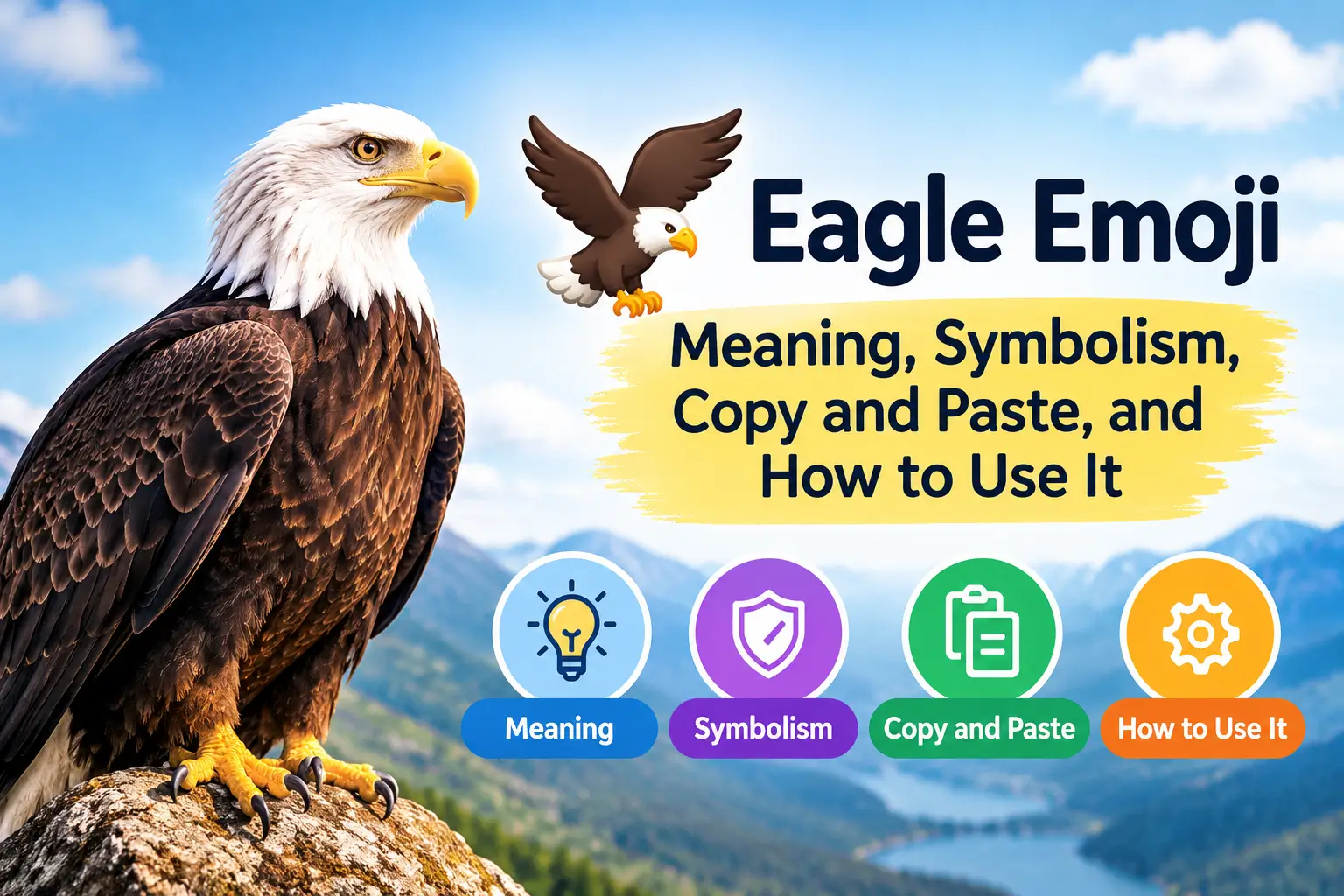
One small symbol can carry a surprisingly big message. The 🦅 emoji can point to an actual bird, but it can also suggest freedom, strength, courage, ambition, pride, or fierce determination.
Its meaning depends heavily on the words around it. Send 🦅 alongside a photo of a mountain and it may simply represent wildlife. Add it to a victory post and it can feel like a badge of power. Pair it with 🇺🇸 and the message may take on a distinctly American or patriotic tone.
The character itself has a precise technical identity. Unicode lists 🦅 as “eagle” with the code point U+1F985. It was introduced in Unicode 9.0 and became part of Emoji 3.0 in 2016.
So, what does 🦅 actually mean, and how should you use it?
Let’s break it down.
Eagle Emoji Meaning
At its most basic level, 🦅 represents an eagle, a large bird of prey. Many platforms depict it as a bald eagle with a dark body, pale or white head, hooked beak, spread wings, and visible talons. The exact artwork varies from one platform to another.
Beyond the literal bird, people commonly use the symbol to communicate ideas associated with eagles.
Common meanings of 🦅 include:
- Freedom
- Strength
- Courage
- Independence
- Power
- Confidence
- Ambition
- Pride
- Leadership
- Victory
- Sharp vision or focus
- Nature and wildlife
The important point is that Unicode gives the character the name eagle. Meanings such as freedom, courage, or ambition come from the symbolism people attach to eagles rather than from a formal Unicode definition. Unicode’s official emoji data places it among bird and animal symbols.
That distinction matters. An emoji doesn’t have one secret dictionary meaning that applies to every conversation.
What Does 🦅 Mean in Texting?
In texting, 🦅 often adds an emotional or symbolic layer to a sentence.
For example, if someone writes:
“Finally achieved my goal 🦅”
the emoji may reinforce a feeling of confidence, freedom, or achievement.
If someone says:
“Nothing can hold me back 🦅”
the symbol makes the message feel more powerful and determined.
However, if someone sends:
“Look what I saw during our hike 🦅”
the meaning is probably much more literal. They’re talking about an actual eagle.
Also read this:Rolling Eyes Emoji: Meaning, Copy & Paste, Uses, Examples, and More
Here are some realistic interpretations:
| Message | Likely meaning |
| “We saw an eagle today 🦅” | Actual eagle or wildlife |
| “Time to spread my wings 🦅” | Freedom and independence |
| “Championship secured 🦅🏆” | Victory and pride |
| “Stay focused on the goal 🦅” | Focus and ambition |
| “That performance was wild 🦅🔥” | Power and intensity |
| “USA! 🦅🇺🇸” | American patriotism |
Context does the heavy lifting.
A single 🦅 doesn’t automatically mean “freedom” or “America.” The surrounding words, images, flags, hashtags, and conversation determine how most readers will interpret it.
Eagle Emoji Symbolism
The eagle has carried symbolic meaning across many cultures and historical traditions. That’s one reason a simple bird image can feel much more forceful than a generic 🐦 bird emoji.
Freedom and Independence
Few ideas fit eagle imagery better than freedom.
An eagle flying high above the ground naturally lends itself to metaphors about independence, escape, and personal liberty. That’s why someone beginning a new chapter might add 🦅 to a caption about leaving limitations behind.
For example:
“New chapter. New altitude. 🦅”
The emoji doesn’t literally explain the sentence. Instead, it reinforces the idea of rising above restrictions.
Strength and Power
Eagles are predators, so their image can also communicate strength and dominance.
In sports, fitness, motivational content, and competitive conversations, 🦅 can work almost like a visual exclamation point.
Compare:
“We won.”
with:
“We won. 🦅🔥”
The second version feels more energetic and triumphant.
Courage and Confidence
Eagles also make useful shorthand for a bold attitude.
Someone might use 🦅 after announcing a difficult decision, starting a business, entering a competition, or celebrating a personal milestone.
It says, in effect, “I’m going for it.”
Vision and Ambition
The eagle’s reputation for powerful eyesight has also made it a natural metaphor for focus and perspective.
That’s particularly useful in motivational posts:
“Keep your eyes on the bigger picture. 🦅”
Here, the symbol supports the idea of staying focused rather than simply referring to a bird.
Leadership and Pride
Eagle imagery often appears in emblems, coats of arms, organizations, military symbolism, and sports identities. As a result, 🦅 can suggest authority, leadership, pride, or group identity.
Still, tone matters. In a casual message, the same symbol may simply mean “strong” or “awesome.”
How the 🦅 Emoji Is Used in Different Contexts
The meaning shifts quickly depending on where you place it.
| Context | Possible meaning |
| Nature | Eagle, birdwatching, wildlife |
| Adventure | Freedom, mountains, exploration |
| Motivation | Ambition, focus, strength |
| Sports | Team pride, victory, competitive energy |
| Fitness | Power, discipline, determination |
| Patriotism | National pride |
| Business | Leadership, confidence, ambition |
| Travel | Wilderness, altitude, adventure |
| Personal achievement | Success and independence |
| Memes | Exaggerated confidence or humor |
This flexibility explains why 🦅 works across so many types of online communication.
🦅 Copy and Paste
Want to use the symbol immediately?
🦅
You can copy it directly into:
- Text messages
- Instagram captions
- TikTok captions
- Facebook posts
- X posts
- Discord messages
- WhatsApp chats
- Profile bios
- Comments
- Digital invitations
You can also combine it with other symbols to create a more specific mood.
Popular combinations
| Combination | Common interpretation |
| 🦅🔥 | Power, intensity, confidence |
| 🦅💪 | Strength and determination |
| 🦅🏆 | Victory and achievement |
| 🦅🌎 | Freedom, exploration, global ambition |
| 🦅⛰️ | Mountains, nature, adventure |
| 🦅✨ | Greatness or inspiration |
| 🦅❤️ | Pride, admiration, or affection |
| 🦅🚀 | Ambition and reaching new heights |
| 🦅🇺🇸 | American pride or symbolism |
| 🦅🪽 | Flight, freedom, or soaring |
These combinations don’t have fixed official meanings. They’re visual associations that readers interpret from context.
Eagle Emoji Examples for Everyday Messages
A good emoji should feel like part of the sentence rather than an ornament glued onto it.
Casual messages
- “That was one incredible view 🦅”
- “We’re finally doing it 🦅”
- “Keep going. You’re almost there 🦅”
- “What a comeback! 🦅🔥”
- “That hike was unforgettable 🦅⛰️”
Motivational captions
- “Rise above the noise. 🦅”
- “Think bigger. Fly higher. 🦅”
- “Eyes on the goal. 🦅”
- “Built for the climb. 🦅⛰️”
- “Freedom looks good from up here. 🦅”
Achievement posts
- “Hard work paid off 🦅🏆”
- “Mission accomplished. 🦅🔥”
- “One goal down. More to come. 🦅”
- “Earned, not given. 🦅💪”
Notice the pattern. The emoji works best when it reinforces an existing idea instead of trying to carry the entire message.
Eagle Emoji and National Symbolism
The eagle has a particularly strong association with the United States because the bald eagle is the country’s national bird and appears on the Great Seal of the United States.
That’s why 🦅 can sometimes carry a patriotic meaning, especially when combined with 🇺🇸.
For example:
“Proud to call this country home 🦅🇺🇸”
has a much clearer patriotic meaning than simply:
“🦅”
However, don’t assume that every eagle emoji is a reference to the United States.
Eagles appear in national symbols, heraldry, sports identities, mythology, and cultural traditions around the world. The emoji itself is officially just eagle. (Emojipedia)
Eagle Emoji in Sports and Team Culture
Sports fans frequently use eagle imagery because the bird naturally suggests strength, speed, competition, and dominance.
One especially recognizable example is the Philadelphia Eagles of the NFL. The eagle emoji can therefore appear in posts celebrating the team, its players, or game-day results. Emojipedia specifically notes this association. (Emojipedia)
But sports usage extends beyond one team.
A school, club, or amateur team with an eagle mascot may use 🦅 as a shorthand for team identity.
Example
“Game day! Let’s get this win 🦅🏆”
Here, 🦅 isn’t necessarily talking about wildlife. It’s acting as a visual representation of competitive spirit or team identity.
Eagle Emoji in Nature and Wildlife Conversations
Sometimes the simplest interpretation is the correct one.
If you’re discussing birds, national parks, conservation, hiking, photography, or wildlife, 🦅 can literally represent an eagle.
For example:
“We spotted an eagle circling over the lake 🦅.”
That’s different from:
“Keep climbing. 🦅”
The first sentence uses the symbol as a literal animal reference. The second uses it metaphorically.
This distinction helps prevent overinterpreting emojis. Not every symbol needs a hidden message.
Eagle Emoji vs. Other Bird Emojis
Not all bird emojis communicate the same feeling.
| Emoji | Main idea | Typical tone |
| 🦅 | Eagle, strength, freedom | Powerful |
| 🐦 | Generic bird | Neutral |
| 🕊️ | Dove, peace | Gentle |
| 🦉 | Owl, wisdom | Thoughtful |
| 🦚 | Peacock, beauty, pride | Flashy |
| 🦜 | Parrot, tropical bird | Playful |
| 🦆 | Duck | Casual or humorous |
If you want to communicate power or freedom, 🦅 is much stronger than 🐦.
If you’re talking about peace, 🕊️ usually makes more sense. For wisdom, 🦉 fits better.
The choice of bird changes the emotional temperature of the message.
How Eagle Emoji Artwork Changes Across Platforms
One interesting detail often gets overlooked: the character and the artwork aren’t the same thing.
Unicode defines the underlying character. Individual platforms create their own visual designs.
As a result, 🦅 may look somewhat different on Apple, Google, Microsoft, Samsung, X, OpenMoji, and other systems. Some designs show more of the body, while others emphasize the head or wings. Emojipedia notes that historical platform designs have differed significantly. (Emojipedia)
This is similar to using the same word in different fonts. The presentation changes, but the underlying character remains the same.
Why this matters
Suppose you send 🦅 from one device to another. The recipient’s system may render a different-looking eagle.
That doesn’t mean you sent a different emoji.
It means the receiving platform uses its own emoji artwork.
Eagle Emoji Unicode Facts
For anyone interested in the technical side, the character has a clear place in the Unicode standard.
| Property | Detail |
| Character | 🦅 |
| Unicode name | EAGLE |
| Code point | U+1F985 |
| Unicode version | 9.0 |
| Emoji version | 3.0 |
| Unicode block | Supplemental Symbols and Pictographs |
| General category | Other Symbol |
| Emoji group | Animals & Nature |
| Subgroup | Animal-Bird |
Unicode’s emoji charts identify U+1F985 as “eagle.” (Unicode)
The character was introduced alongside a large collection of animal symbols in Unicode 9.0. The official Unicode chart places eagle between unicorn face and duck within the animal-symbol section. (Unicode)
That’s a useful technical fact because it explains why 🦅 isn’t simply an image pasted into a message. It’s an encoded character that compatible software can render using an emoji font.
When Should You Use 🦅?
The easiest rule is simple:
Use 🦅 when you want to represent an eagle literally or evoke qualities commonly associated with one.
That includes:
- Wildlife observations
- Outdoor adventures
- Personal victories
- Motivational posts
- Independence
- Confidence
- Sports celebrations
- Ambition
- Patriotism when the surrounding context supports it
- Strength and determination
A quick decision guide
Talking about an actual eagle?
Use 🦅 literally.
Celebrating a big win?
Use 🦅 to add confidence and power.
Talking about freedom?
🦅 can reinforce the metaphor.
Posting something patriotic?
🦅 may work especially well alongside 🇺🇸 when the context is American.
Talking about peace?
Choose 🕊️ instead.
Talking about wisdom?
🦉 may communicate the idea more clearly.
The best emoji isn’t necessarily the most dramatic one. It’s the one that fits the message.
A Simple Case Study: How Context Changes the Meaning
Consider three messages containing the same emoji.
Message A
“We saw two eagles near the river today 🦅.”
Meaning: Literal wildlife reference.
Message B
“No more excuses. It’s time to chase the goal 🦅.”
Meaning: Focus, ambition, and determination.
Message C
“What a victory! 🦅🏆🔥”
Meaning: Competitive energy, pride, and celebration.
Same symbol. Three different messages.
That’s the real lesson behind emoji interpretation: context beats assumptions.
Read this also:Red X Emoji Meaning, Copy and Paste, Uses, and Unicode Facts
Final Takeaway
The 🦅 symbol is far more versatile than its simple appearance suggests. At its most literal, it represents an eagle. In everyday digital communication, though, it can also suggest freedom, strength, courage, independence, ambition, pride, focus, or victory.
Its official Unicode identity is straightforward: U+1F985, EAGLE, introduced in Unicode 9.0 in 2016.
What makes it interesting is everything people build around that basic character.
Use it for a wildlife sighting. Add it to a motivational caption. Pair it with 🏆 after a win. Combine it with 🇺🇸 when you clearly mean American symbolism. Or simply drop 🦅 into a message when you want a little more force behind your words.
In short, the 🦅 emoji works best when the image and the message point in the same direction. When they do, one tiny bird can make the whole sentence take flight.
FAQs About the Eagle Emoji 🦅
The Eagle Emoji 🦅 commonly represents strength, freedom, courage, power, independence, and confidence.
In texting, the Eagle Emoji can express confidence, determination, freedom, ambition, or admiration for eagles and nature.
You can simply copy this Eagle Emoji 🦅 and paste it into messages, social media posts, captions, comments, or profiles.
The Eagle Emoji symbolizes freedom, strength, vision, courage, leadership, and independence.
Yes. You can use the Eagle Emoji 🦅 in Instagram captions to add a bold, powerful, adventurous, or patriotic feel.
On social media, 🦅 can represent confidence, ambition, freedom, power, patriotism, or a connection with nature.
Yes. The Eagle Emoji works well with motivational messages about reaching goals, staying strong, taking risks, and achieving freedom.
Yes. The Eagle Emoji 🦅 can be added to a social media bio to express strength, independence, confidence, or an adventurous personality.
The Eagle Emoji 🦅 is represented by the Unicode character U+1F985.
Popular combinations include 🦅🔥 for power and passion, 🦅💪 for strength, 🦅🌎 for freedom and adventure, and 🦅✨ for confidence and inspiration.
2 thoughts on “Eagle Emoji 🦅: Meaning, Symbolism, Copy and Paste, and How to Use It”